Google Discover traffic drop, what publishers should check now

Traffic from Google Discover collapses, and nobody knows why? For many publishers the feed is now the most important Google channel, so the loss hits hard.
I have analysed and accompanied several of these drops. Most recently at a client who fell to 9,000 clicks a day and today reaches several hundred thousand again.
Update situation 2026
What changed at Google
Some drops do not have their cause on your own website at all, but at Google. That is why the first look goes to the update situation.
The first standalone Discover core update
From 5 to 27 February 2026 Google rolled out a core update for the first time that relates exclusively to Discover, documented in the Google Search Status Dashboard. According to Google it is meant to improve the quality of Discover overall.
The rollout took 22 days and initially applied to English-speaking users in the US.
So put the date of your drop on the update timeline. If the crash coincides with an update window, that changes the whole assessment.
Google's documentation says that because Discover is an extension of Google Search, updates can sometimes lead to changes in traffic. So classic core updates and spam updates also hit Discover.
Why Discover fluctuates in principle
Discover traffic fluctuates more than search traffic because Google pushes it proactively and no user searches for it. If interest in the topic shifts, reach falls without any action on your part.
Weak phases can last weeks or months; for some publishers the traffic never returns. All the more important to know the cause instead of optimising blindly.
Anyone who relies on Discover alone risks the next drop with every update. A diversified traffic mix of newsletter, direct visits and social therefore remains mandatory.
Causes
The most common causes, and how to recognise them
If the update situation is not enough as an explanation, the cause almost always lies in-house. In my analyses the same suspects keep showing up.
Mass republishing and thin stories
Most often I see new URLs or new dates for existing articles without a real content update. Such mass without substance competes with the same quality filters as every search result, because according to Google Discover uses many of the same signals and systems as Search.
Three patterns in particular have become risky since the 2025/26 spam updates, post-dating the publication date without a content update, giving existing articles new URLs, swapping title and image without adding content.
Republishing still works, but only with a real update and a transparent update note in the article. How that works cleanly is explained in the guide How does republishing work?
And if an article is going through the roof on its own, the simplest rule in publisher SEO applies, do not touch it.
Diluted topic focus
Google rewards publishers that report regularly and reliably on their core topics. Anyone who fills the feed with random trending topics dilutes their profile; Google then no longer recognises what the site stands for.
So check whether the losing URLs still belong to your core topics. Which those are is shown by the Search Console data of the past months, not by the newsroom's gut feeling.
Weak Core Web Vitals
Technology alone can trigger a drop. If CLS or INP deteriorate, for example through aggressive ad integrations or jumping mobile layouts, Discover visibility can fall.
Images are part of it too. For the large display in the feed Google requires at least 1,200 pixels width and the setting max-image-preview:large.
This is exactly the pattern the case from the introduction showed. In mid-July 2025 my client's crash began, from several hundred thousand Discover clicks a day to 9,000 in autumn.
INP and CLS were deep in the red, plus a lost topic focus and massive republishing without updates. None of the three causes explained the drop alone.
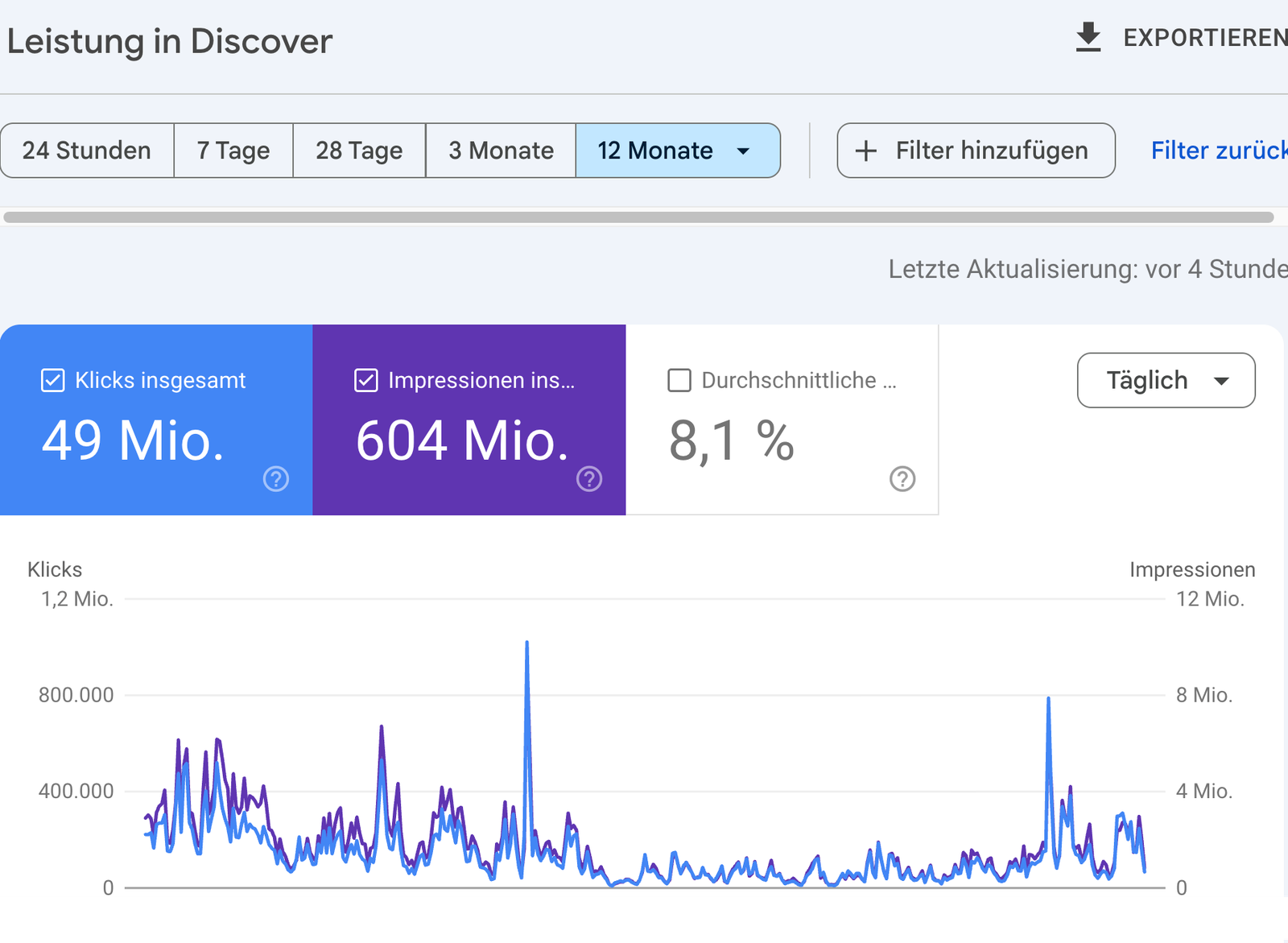
After technical optimisation, measured republishing and an entity analysis the client was back in the feed shortly before Christmas 2025. At year end he reached almost 800,000 visits; the full trajectory is documented in the case study on the Google Discover comeback.
Extreme clickbait
Google's Discover content policies do not allow preview content that fakes details not covered in the actual content. The documentation also explicitly warns against titles aimed at morbid curiosity, titillation or outrage.
Check the losing URLs for exactly such headlines. If they pile up, you have your cause.
Missing author signals
Discover uses the same systems as Search to determine which content is helpful and people-first. You know the grid behind it as E-E-A-T.
For that Google needs author profiles with a face and a CV, traceable sources and a reachable newsroom. Anonymous mass reporting delivers none of these signals, especially critical in health, finance and politics.
Discover pieces behind the paywall
The paywall can be the trigger too. If articles with running Discover traffic move behind the wall, readers bounce back into the feed after the click, and the traffic stays away.
What has proven itself, take pieces with strong Discover inflows out of the paywall for the duration of the run. Subscriptions do not come from content that is free elsewhere anyway.
Manual action or measurement error
Open the section Security & manual actions in Search Console. If a website violates the Discover content policies, the entry Manual actions for Discover appears there; then fixing it takes priority over everything else.
If the section stays empty, the drop can also be a measurement error. On the page Data anomalies in Search Console Google lists documented logging errors.
For May and June 2026 alone there are three errors listed that reported Discover clicks too low. Two minutes of checking before someone panics and throws out the strategy.
Practice
How to approach the drop
From the update situation and the list of causes follows an order that has proven itself in my engagements.
- Rule out measurement errors and manual actions, check the data anomalies page and Search Console.
- Put the date of the drop on the update timeline, Discover core update, core updates, spam updates.
- Measure the Core Web Vitals of the losers, CLS and INP first, plus image sizes.
- Check the content patterns of the losers, republishing without updates, clickbait, author signals.
- One change per test, measure the effect over weeks against unchanged comparison URLs.
FAQ
Frequently asked questions about Google Discover drops +
Why is Google Discover suddenly gone?
A sudden decline comes from a measurement error, a technical change, a Google update, shifting user interests or quality problems such as clickbait and thin content. Search Console shows the loss, but not the cause.
How long does recovery after a Google Discover drop take?
Google names no fixed duration. For losses after core updates Google speaks of a few days to several months until the systems have reassessed a website.
Can a Google core update lower Discover traffic?
Yes. Google describes Discover as an extension of Google Search, so updates to Search can also change Discover traffic.
What counts as clickbait in Google Discover?
Google prohibits preview content that fakes details the article does not cover, as well as sensational titles aimed at morbid curiosity, titillation or outrage. For violations Google can impose manual actions for Discover.
What is the Discover core update of February 2026?
The first core update that relates exclusively to Google Discover, rolled out from 5 to 27 February 2026, initially for English-speaking users in the US. According to Google it is meant to improve the quality of Discover overall.
Transparency
Sources used
- Own experience from analysing and accompanying publishers with Discover traffic.
- Google Search Status Dashboard: "February 2026 Discover update".
- Google Search Central: "Discover and your website".
- Google Search Help: "Discover content policies".
- Google Search Console Help: "Performance report (Discover)".
- Google Search Console Help: "Data anomalies in Search Console".
- Google Search Central: "What are core updates and what do they mean for your website?".
- Moritz Serif: "Case study: the Google Discover comeback".
Has your newsroom lost traffic in Google Discover?
In the initial call we sort your data, the technical changes and the editorial patterns, and decide which cause we check first.
Discuss the drop